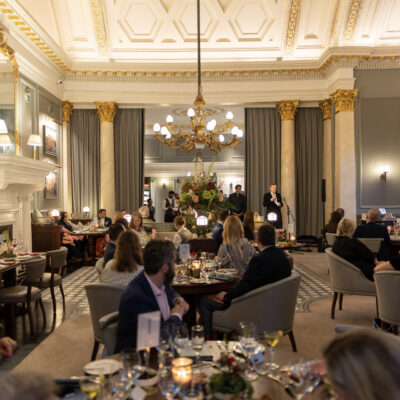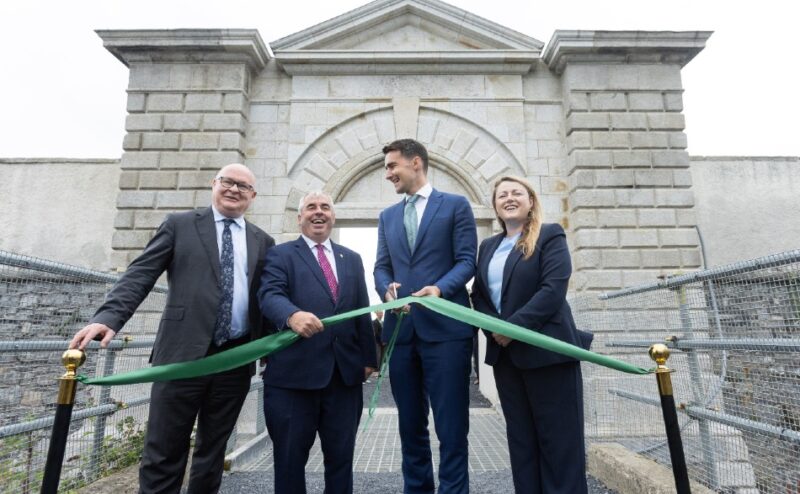
The Office of Public Works (OPW) has welcomed the re-opening of the historic Magazine Fort, Dublin after completion of the first phase of conservation and stabilisation works. Set in the Phoenix Park, the Magazine Fort is one of Dublin’s most significant heritage landmarks. Originally built in the 18th century as a military storage facility for gunpowder, it later played a role in the events of the Easter Rising in 1916 and was used by the Irish Army before transferring to the OPW in 1988. The first phase of works involved extensive repair and conservation works of the fort’s rampart walls, cavaliers, gunpowder store buildings, the 1921 Bakery building and reinstated the Duke of Dorset Gateway. The project team worked to balance the needs of conservation with the practical requirements of a modern public heritage site.
Speaking at the event Minister for Public Expenditure, Infrastructure, Public Service Reform and Digitalisation, Jack Chambers said “I am delighted to mark the reopening of the Magazine Fort following the successful completion of this important phase of conservation works by the OPW. This investment demonstrates the Government’s ongoing commitment to conserving and enhancing our built heritage while making it more accessible to the public.
The nearby commemorative bridge which is under construction by the OPW will link the Fort with the Irish National War Memorial Gardens and create an iconic focal point for locals and tourists alike to take in the views of the River Liffey, the Salmon Weir, the boat clubs, Fort, – providing not only a piece of transport infrastructure, but an architectural and urban amenity space. These two capital development projects will boost tourism in this area while also being a driving force for community gain.”
Speaking at the opening, Minister of State with responsibility for the OPW, Kevin “Boxer” Moran, said: ‘The Magazine Fort is one of OPW’s most iconic historical sites and its careful preservation is an important part of our shared heritage. The ongoing conservation works to this site ensures that this landmark is protected, enhances public understanding of its history and ensures that it remains protected for future generations to appreciate and enjoy. I am delighted to be here today for the reopening of the Magazine Fort’.
The works were completed as part of a phased reopening of the site to the public. Future conservation work include making the Francis Johnston buildings accessible to visitors and enhancing the site’s overall visitor experience.
The project is funded under the National Development Plan, with Government investment to date of €5.7 million (including VAT). The project has already received major recognition as the recipient of the RIAI Awards 2026 (Conservation category) and the Irish Construction Excellence Awards 2026 (ICE Award) in the Heritage/Conservation category.
The Magazine Fort is now open for public guided tours through the OPW Phoenix Park Visitor Centre. For more information about tours of the Magazine Fort please visit www.heritageireland/magazinefort. For further information about our sites visit www.heritageireland.ie.
Magazine Fort
The Magazine Fort in the Phoenix Park is a significant surviving Magazine Fort in the country. The complex has had a long history of continuous use spanning three centuries. It is considered to have special architectural, military, historical, social and archaeological interest. The Magazine Fort is a Protected Structure in the Dublin City Council Development Plan 2016 – 2022.
Construction of the Magazine Fort (formerly the Royal Magazine Fort), designed by John Corneille Junior, began from c.1736 on the high ground occupied by the Phoenix House (1611), a strategic location for military purposes with commanding views of the city and surroundings. The fort was built for the storage of gunpowder and was managed by the Military Authorities until 1988 when it was decommissioned and transferred to the Office of Public Works. The fortification is a typical square plan with four demi-bastions and a dry moat.
Architecturally, the complex is the product of successive phases of adaptation and addition, typical of an enclosed military site. The Fort occupies a strategic location within the Phoenix Park within which it stands out as one of its main architectural landmarks.
The restored Fort is expected to have a capacity of 430 visitors at any one time, with visitor numbers in the region of 150,000 per annum anticipated over time.